
Project | About 4-6 weeks
Project | About 4-6 weeks
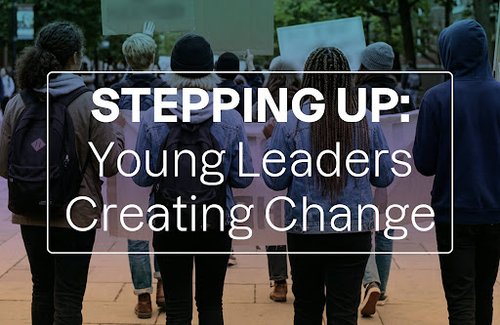
Young leaders have been at the forefront of major changes in U.S. history– from civil and labor rights to anti-war protests– they continue to make waves today. For this project, find a teen or young adult in your community who is using their voice to speak up about an issue they care about and working to make change happen. Create a video profile of this person.
NOTE: As part of the 2026–2027 school year, we’re inviting students to pitch stories inspired by topics and themes. This is our spring prompt. Use this rubric to help shape your idea to create a strong, engaging video package.
A video profile is the story of one person. It typically has voiceover (VO), b-roll, pictures, nats (natural sound), and may include interviews of family members, colleagues, or peers of that one person. Here’s an example of a profile.
Use these questions to help you highlight a young leader:
Watch SRL’s LEVEL-UP TUTORIAL SERIES before you begin filming
Create a profile of a young leader: Find someone in your community who is working to create change.
Extension activity: Dig into U.S. history. How have youth activists spurred change in the past? What issues were they working on? What kinds of obstacles did they face? What were the lingering effects of their actions? For example, the Tinker v. Des Moines Independent School District Supreme Court case was spurred by students who were disciplined by their school for protesting the Vietnam War by wearing black armbands. The landmark ruling by the court held that students retained their First Amendment rights while at school as long as their expressive acts did not “materially or substantially interfere” with the school’s operation. It remains the basis of our modern understanding of students’ free speech rights in school
Journalism is the activity of gathering, assessing, creating, and presenting news and information.
Ethical journalism strives to ensure the free exchange of information that is accurate, fair and thorough. An ethical journalist acts with integrity. Ethical journalism should be accurate and fair. Journalists should be honest and courageous in gathering, reporting and interpreting information.
Belief that someone or something is reliable, good, honest, effective, etc.
A group of people who live in the same area (such as a city, town, or neighborhood). It can also be a group of people who have the same interests, religion, race, etc.
Investigating and explaining, in a critical and clear-eyed way, how people try to solve widely shared problems. Solutions journalism focuses on responses to problems.
A description of what your story might be and WHY it’s important. An outline of your story idea and the steps to achieve your goal. A summary of what you hope to accomplish in your story
A document with transcribed (written-out) soundbites and voiceover narration. A VIDEO script is a two-column document with the audio (soundbites and voice over) in the right-hand column and a description of what the audience sees (visuals) in the left-hand column.
The story of one person, has voiceover (VO), b-roll, pictures, nats (natural sound), interviews of family members or peers of that one person.
Students recognize the responsibilities and opportunities for positively contributing to their digital communities. (ISTE)
Historical understanding requires recognizing this multiplicity of points of view in the past, which makes it important to seek out a range of sources on any historical question rather than simply use those that are easiest to find. It also requires recognizing that perspectives change over time, so that historical understanding requires developing a sense of empathy with people in the past whose perspectives might be very different from those of today. (NCSS D2.His.4.9-12 - D2.His.8.9-12)
In order to act responsibly and effectively, citizens must understand the important institutions of their society and the principles that these institutions are intended to reflect. That requires mastery of a body of knowledge about law, politics, and government. (NCSS D2.Civ.1.9-12 - D2.Civ.6.9-12)
Journalism
Race and Justice
Civics
Elections
Digital Literacy/Citizenship
Intermediate
Mic
Computers
Camera or Mobile Phone
Camera
Mobile Phone
Internet
About 4-6 weeks